Last reviewed October 16, 2026. General information, not legal or professional advice. Check the linked sources for the current rules.
How a ready-mix drum truck works
Ready-mixed concrete is batched at a plant and delivered in a truck mixer that keeps it mixed until it's discharged at your site. Its specification is ASTM C94 (ASTM C94/C94M). The amount is set when the truck is loaded, and NRMCA puts the capacity of a drum truck at 8 to 12 cubic yards (NRMCA CIP 31).
The clock starts at the plant. NRMCA says concrete normally sets and hardens two to eight hours after mixing, and its hot-weather sheet says to avoid adding water to concrete that's more than an hour and a half old (NRMCA CIP 12). Traffic, a late inspector or forms that aren't quite ready all come out of that time.
How a site-mix truck works
A volumetric mixer is a small batch plant on a truck. Sand, stone, cement and water ride in their own compartments and are combined at the job site just before the pour (VMMB). Concrete made this way has its own specification, ASTM C685, which covers concrete batched by volume and mixed in a continuous mixer (ASTM C685/C685M).
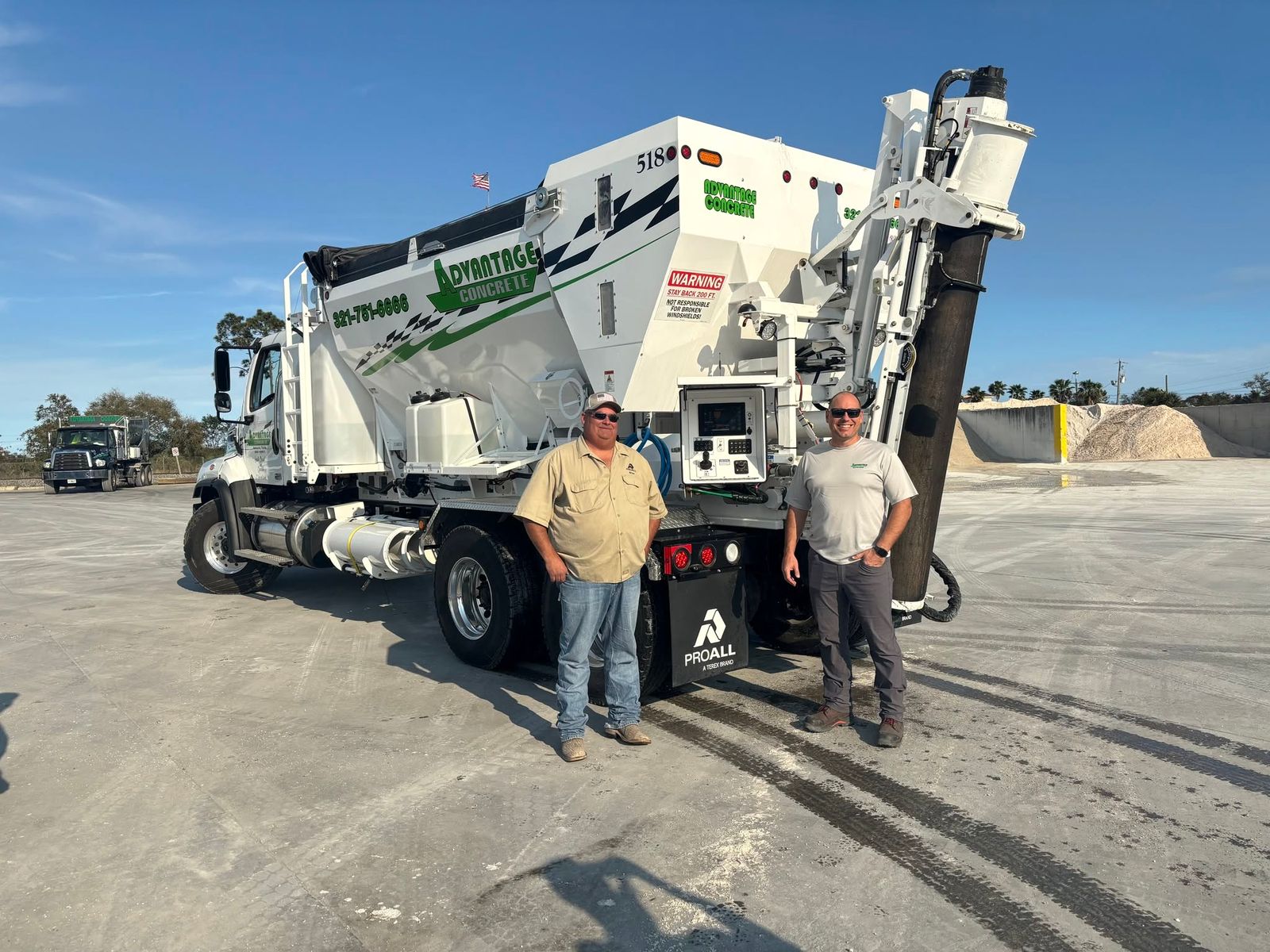
Because the mixing happens at your forms, the operator makes what the pour takes and then stops. Material that wasn't needed stays dry on the truck instead of turning into a leftover load. Ours are the white trucks with green lettering.
When site-mix is the better fit
Site-mix earns its place on jobs where the amount is small, uncertain or spread out:
- Short loads. A pad, a few footers or a sidewalk, where a full drum would be far more than the job uses. The VMMB notes that even the smallest quantities of specialty concrete can be made fresh on site, which cuts waste (VMMB). See short loads.
- Pours where the yardage is a guess. Uneven ground, hand-dug footers and odd-shaped forms all throw an estimate off. The yardage guide covers the math.
- More than one pour at the same address. Footers now and a slab when its forms are ready, mixed as each one is ready, without a second plant order.
- Days where waiting is likely. If the inspection runs late or the forms need another hour, unmixed material isn't setting up in a drum.
When a drum truck makes more sense
Some jobs fit a plant better, and it's worth saying so. A very large pour with a known volume, where a line of drum trucks can keep concrete arriving one after another, is one of them.
Another is a job whose specifications name ASTM C94 and say nothing about C685. Ask the engineer or the building department whether site-mixed concrete is acceptable before you order. Either way, send the plans with your quote request. See commercial pours and concrete for contractors.
Side by side
The same questions, answered for each truck:
| Question | Site-mix (volumetric) truck | Ready-mix drum truck |
|---|---|---|
| Where is it mixed? | At your job, just before it goes into the forms | At the plant or in the drum on the way |
| How much comes? | What the pour uses, mixed as it goes | The amount loaded at the plant |
| What if you're short? | The operator keeps mixing while there's material on board | Another load has to be ordered and batched |
| What if there's extra? | It stays on the truck as dry material | Leftover concrete has to go somewhere |
| Specification | ASTM C685 | ASTM C94 |
Questions people ask
Is site-mixed concrete as good as ready-mix?
Both are covered by ASTM specs, C685 for volumetric and C94 for ready-mix. Whether site-mixed concrete is accepted on a given job is the engineer's or the building department's call, so ask before you order.
What if the site is running behind on pour day?
Call us as soon as you know. Nothing is mixed until the operator starts, so a short delay doesn't leave a load setting up in a drum.
Is a site-mix truck smaller than a drum truck?
Not necessarily, and it's still heavy when it's loaded. Show us where it can park on firm ground. The pour planning guide has a full prep list.
Sources
- ASTM C94/C94M, Standard Specification for Ready-Mixed Concrete
- ASTM C685/C685M, Concrete Made by Volumetric Batching and Continuous Mixing
- NRMCA, CIP 31: Ordering Ready Mixed Concrete
- NRMCA, CIP 12: Hot Weather Concreting
- VMMB, Volumetric mixing provides high-tech solution for concrete applications (2020)
- Volumetric Mixer Manufacturers Bureau, About